Category: Models

  • Gemma4:12b experience

    I’m playing around with Local LLMs again! Using Gemma 4 12b on my underpowered Mac M4 and it is good. Much better than when I first played with Gemma 4 E4B. The tool calling is so much better and the general day to day feels crisp. I’m not doing any benchmarks, just running my life.

    A lot of r/LocalLLM chatter is because it is the first model to run on laptop class 16GB RAM, the likes of MacBook Pros with unified memory. And it does! Barely. Running in oMLX cost me 11GB. Was like living in 640K memory in the DOS days. Closing everything in activity monitor. A more realistic scenario is using the GGUF 8GB which is survivable. Anyway, point is, if we were not in 2026, living memory poor, one can easily see a future where laptops shipped with local LLMs doing real work, real tool calls, all privately….with more RAM.

    Exploring this further I wanted to see what was new in the 12B architecture and went down a small rabbit hole about why Google released 12B and its architecture in their developer post.

    Gemma 4 12B introduces several milestones for local AI:

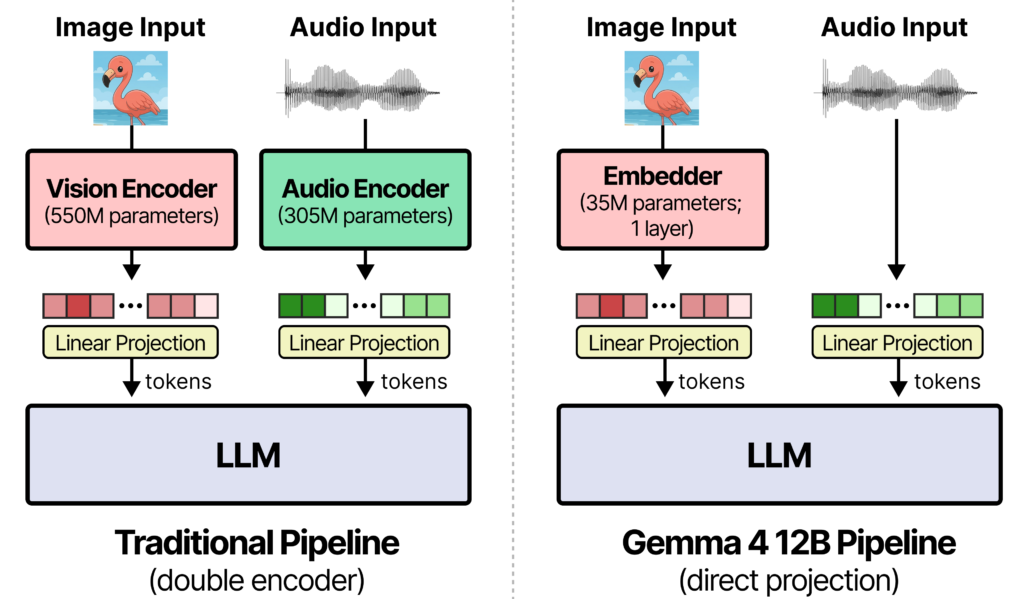
    1. A multimodal encoder-free architecture: Bypassing heavy multi-stage vision and audio encoders entirely, multimodal data is fed straight into the LLM backbone, reducing multimodal latency.
    2. Our first medium-sized model with audio input: In the Gemma family, audio inputs were restricted to small, lightweight edge architectures (e.g. E4B). Gemma 4 12B is the first medium-sized model capable of natively ingesting audio.

    Gemma4 being encoder free was a new one to me. On their developer post they had this image which only confused me more.

    Thankfully, they also included a link to Maarten Grootendorst’s post A Visual Guide to Gemma 4 12B which explains it eloquently. Every few month there are new optimizations and ideas on how to fit more into less.

  • Gemma4 12b

    With Nvidia announcing the RTX Spark to challenge Apple’s MX reign on local LLMs, it is appropriate that Google dumped some toys on us the next day.

    Gemma4 12B is out today, in a sweet spot between their prior 8B and 26B I’m super interested to see how it stands up. 8B was a great chatbot, but a terrible tool bot. 26B seems much better but I could never run it on my M4 Mac mini 16GB. Does Google see 12B is “about right” for most spec’d out systems today – it runs on 16GB! Downloading now….

    Unexpectedly, Google added to LiteRT-LM a local LLM server / CLI!

    The LiteRT-LM CLI provides a lightweight, zero-code tool for running language models locally. We are now expanding the tool with the serve command, letting the CLI act as a drop-in local LLM server. Use this functionality with Gemma 4 12B to point any standard tool, SDK, or framework (such as OpenClaw, Hermes, OpenCode, Pi, or popular extensions like Continue and Aider) directly to your local endpoint.

    Aside from the fact that the internets are saying RTX spark is going to cost $5000+ it does not seem far away where local models, even on edge devices (looking at you iOS27),may start to be competitive with cloud for basic stuff. Not coding, not tool use, not yet. But everyday things, like voice typing, opening apps, regular analysis, asking offline questions, could be done in the very near future all on local LLM.

  • 4.8

    New Opus 4.8 came out. I saw the video announcement on YouTube but what wasn’t captured was this gem in the release notes.

    One of the most prominent improvements in Opus 4.8 is its honesty. We train all our models to be honest—for instance, to avoid making claims that they can’t support. But a general problem with AI models is that they sometimes jump to conclusions, confidently claiming to have made progress in their work despite the evidence being thin. Early testers report that Opus 4.8 is more likely to flag uncertainties about its work and less likely to make unsupported claims. This is borne out in our evaluations, which show that Opus 4.8 is around four times less likely than its predecessor to allow flaws in code it has written to pass unremarked.

    It’s nice to see a feature update focused on improving LLM alignments.

  • Choosing the right model

    Claude had a ton of new talks on youtube after their big conference. I thought the below talk had informative take-aways for model selection. If you’re on a Pro subscription you’re likely stuck mostly on Sonnet, but if you’re on Max, then you have a lot more flexibility on what model you get to run full-time.

    The video had some nice summary slides. Like the block below. Tell me that you knew all this already and you get a shiny reward.

    It was also interesting (and slightly frustrating) to know that sometimes using a newer model, was more efficient. Meaning, just because you run the Sonnet model, doesn’t mean it optimizes the tokens and you get the best result. You could run Opus 4.7, be faster, and save tokens. The explanation made sense. The newer models are smarter, so they reason better and can use tokens more efficiently because they may skip tasks, or death spiral less frequently. But… not always. So you have to evaluate.

    While this makes sense in the context of recurring tasks or prompts, what is still unclear is how might one know what model to use… prior to doing an evaluation. I find this part of the equation partly why it seems easier to just always use Opus 4.7 xhigh. How do I know what result I will get between high vs. xhigh and how my choice of this setting will impact my outcome? This part of model selection is user unfriendly. I’ve noticed that thinking is now “adaptive” rather than an option of yes/no in Opus 4.7. I imagine having the LLM decide based on prompt is likely the best path.

  • Gemma4 MTP

    Google released Gemma4 MTP which incorporates a new feature, speculative decoding. Another lightweight model does token prediction speeding up the work for the larger model making the token speed up to 2-3x.

    I saw an cute ELI5:

    Imagine two bears, a big slow bear and a little nimble bear looking for berries. The little bear runs off first and finds a bunch of berry trees and yells for the big bear. Big bear comes and decides which berry tree is most delicious and makes the final call to grab it.

    Unfortunately for me, my system still cant run it.